01
Calls for service
Create, prioritize, merge, transfer, reopen, close, and annotate calls while preserving incident responsibility and chronology.
AXIOS Dispatch brings call-taking, incident responsibility, unit control, responder safety, mapping, response policy, and supervisory oversight into one realtime operating picture.
Work active incidents without bouncing between disconnected screens. Calls for service, lifecycle timestamps, assignments, responder safety, unit availability, response planning, and mapping remain visible from the same operational workspace.
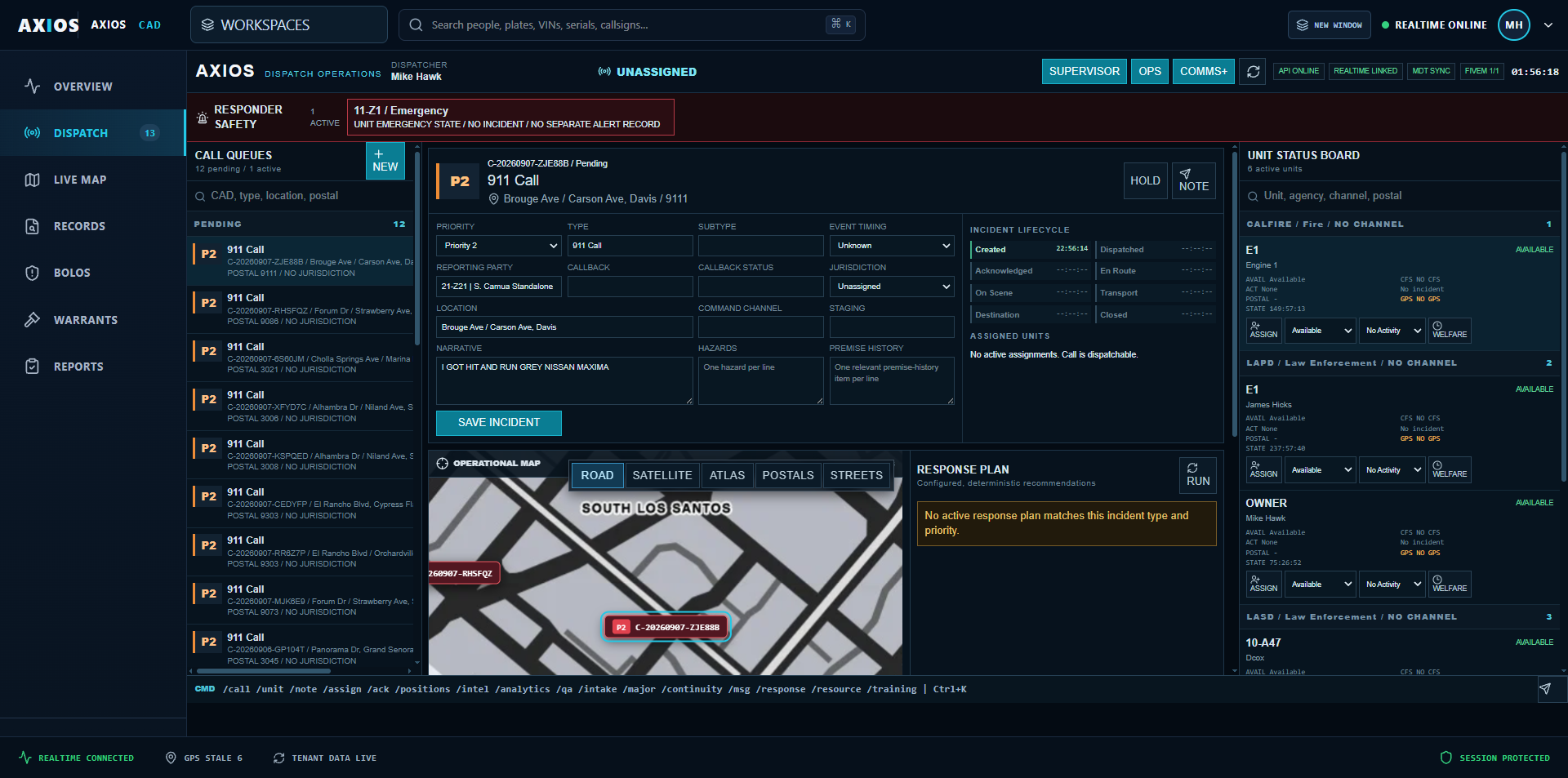
AXIOS keeps the operational lifecycle explicit so the communications center can see what is pending, what is assigned, what changed, and what still requires action.
Create, prioritize, merge, transfer, reopen, close, and annotate calls while preserving incident responsibility and chronology.
See available and committed resources, assign units, follow status progression, and retain a consistent underlying status model even when community terminology is customized.
Keep typed locations, player-provided coordinates, and available map or postal context distinct so the operating picture reflects the quality of the location data actually received.
Historical unit location can remain disabled, permission-controlled, and retained according to community policy instead of becoming an unrestricted tracking record.
Use community-defined response policy, minimum resources, capabilities, staging, and mutual-aid guidance to support consistent dispatch decisions.
Decision support can work from known CAD data and configured policy while dispatchers remain responsible for assignments, official actions, and operational decisions.
The AXIOS system supports multiple dispatchers operating concurrently, with each dispatcher able to assume a defined area of responsibility such as Law Enforcement, Fire, EMS, or another configured discipline. Operations and Supervisor roles retain broader system visibility to maintain situational awareness across active dispatch functions.
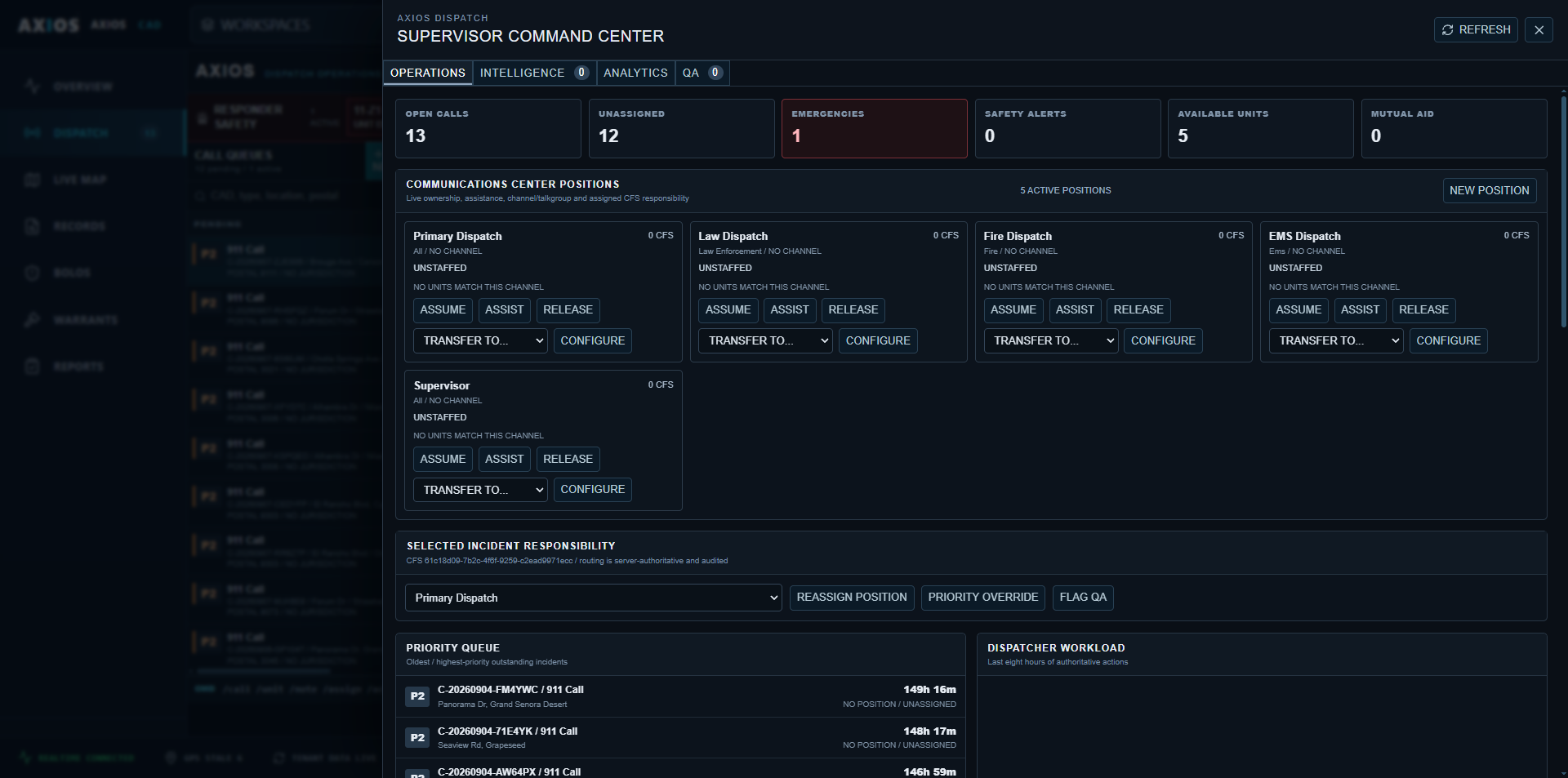
The live operational map combines incident markers, unit availability, assignment context, postals, and configurable map layers in one dispatcher-focused view. AXIOS preserves location provenance so typed locations are not silently represented as precise GPS coordinates.
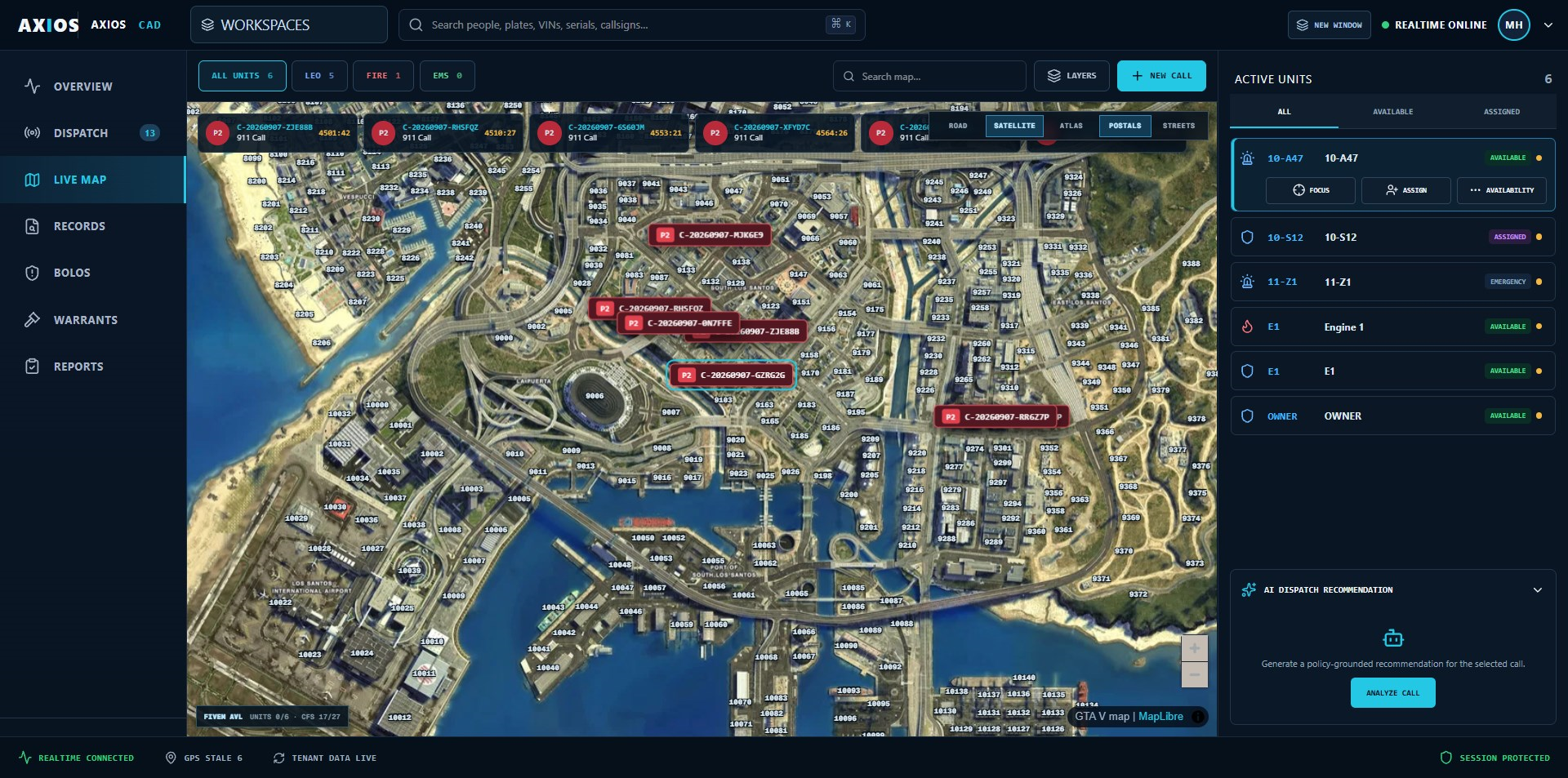
Supervisors can maintain awareness of communications-center workload and responsibility while AXIOS preserves the history needed to understand how the operation moved from intake to final disposition.
See outstanding incidents, unassigned work, dispatcher activity, and unit workload without reducing the operation to a single undifferentiated queue.
Responsibility can be reassigned intentionally while lifecycle timestamps, notes, assignments, and operational history remain attached to the incident.
Communications leadership can review lifecycle performance and workload trends as part of a broader supervisory and quality-assurance workflow.
Start with the workflows your community needs today and retain the operational structure to grow into dedicated Law, Fire, EMS, Operations, and Supervisor responsibilities as staffing expands.